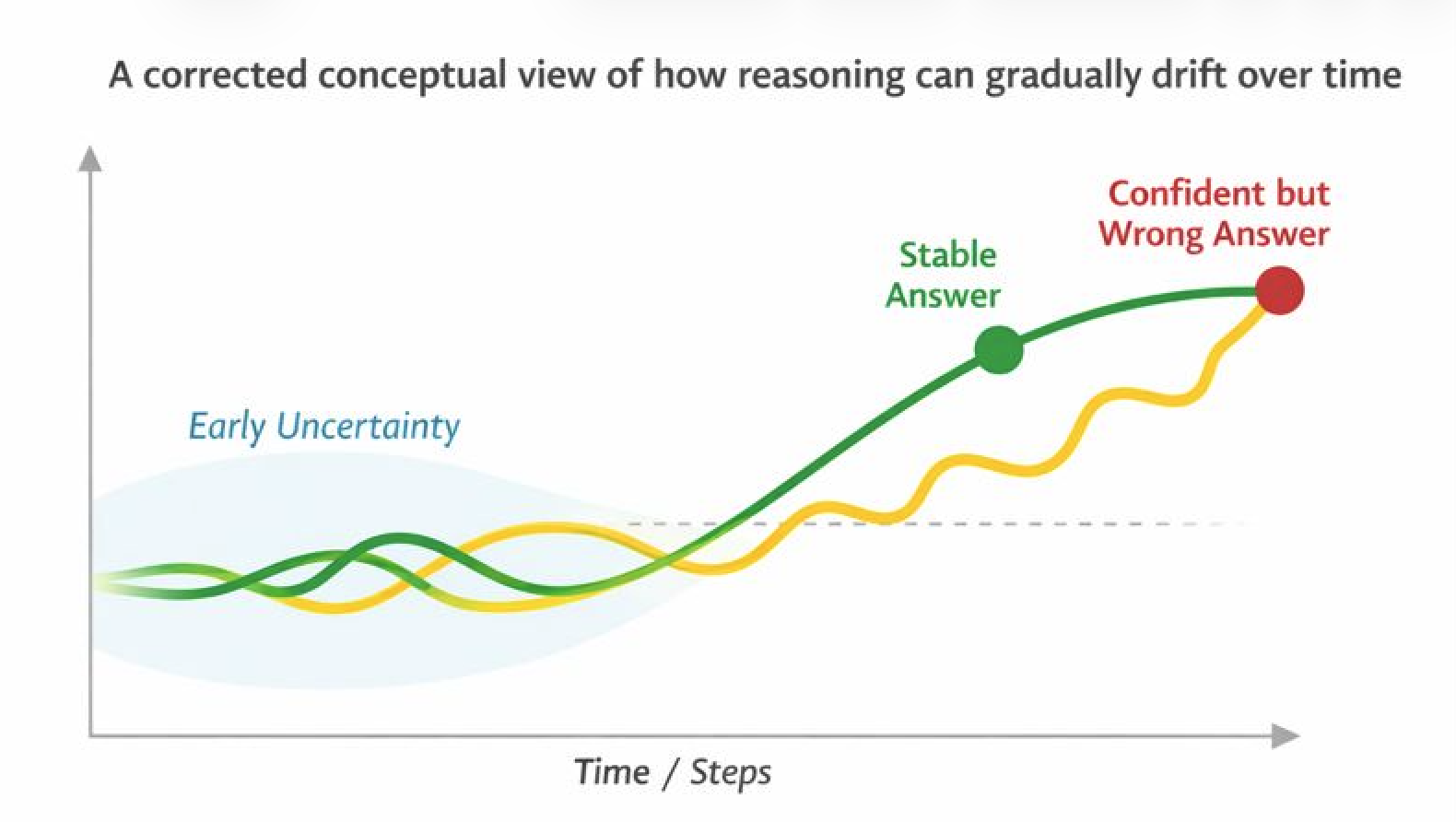
People often describe AI mistakes as sudden failures. One moment the answer seems reasonable and confident, and the next it is clearly wrong. This makes errors feel unpredictable, as if the system simply failed without warning.
But when you look more closely at how AI generates answers, a different picture begins to emerge.
Rather than jumping directly from a question to a conclusion, many modern AI systems produce answers step by step. At each step, the system makes a choice based on what it has already generated. Over time, these choices accumulate. Small changes early on can quietly influence everything that follows.
This means that reasoning does not always fail all at once. Sometimes it gradually drifts.
It is tempting to judge AI systems only by their final answers. Was the response correct or incorrect. Did it match what we expected.
However, this way of thinking hides an important detail. Reasoning unfolds over time. Each step shapes the next one. When early steps become uncertain or unstable, later steps may amplify those effects, even if the final answer still sounds confident.
From the outside, this can look like a sudden collapse. Internally, it may be the result of small shifts that built up across the reasoning process.
Instability in reasoning does not always mean obvious confusion. In fact, it often appears in subtle ways.
An AI might hesitate between multiple possible directions before settling on one. It might change how it frames the problem midway through an answer. It might become increasingly confident in a line of reasoning that is quietly drifting away from the original question.
These changes are easy to miss if we only look at the final output. But they can matter a great deal, especially for tasks that require multiple steps of reasoning.
One of the challenges with AI systems is that fluent language and confident tone are not reliable indicators of stable reasoning. A system can sound certain while its internal decision process is becoming less consistent.
This helps explain a common user experience. You read an answer that feels persuasive, only to realize later that something is off. The problem is not always a lack of knowledge. Sometimes it is the way reasoning unfolded along the way.
Understanding this distinction can change how we interpret AI outputs. Instead of asking only whether an answer is correct, we can also ask whether the reasoning that led to it remained steady.
Thinking about reasoning as a dynamic process has practical implications. It helps explain why asking follow up questions can sometimes improve results. It also explains why rephrasing a prompt or breaking a task into smaller steps can lead to more reliable answers.
More broadly, it encourages a more careful relationship with AI systems. Rather than treating them as tools that either work or fail, we can view them as systems whose reasoning can evolve, drift, and occasionally become unstable.
This does not mean AI reasoning is fragile in every situation. It means that, like many complex systems, its behavior depends on how processes unfold over time.
Paying attention to those processes can help us better understand when AI is likely to stay on track, and when it may begin to wander.